Neutral-atom arrays and AI, in both directions
Why Rydberg tweezer arrays are a good place to put AI to work — and why they might also be a good place to train it.
Neutral-atom tweezer arrays let us hold individual atoms with laser light, arrange them into patterns, and control how they interact (Barredo et al., 2016; Endres et al., 2016; Kaufman & Ni, 2021). This makes them powerful tools for studying quantum many-body physics: how interacting quantum particles collectively produce behavior that cannot be understood by considering each particle alone (Browaeys & Lahaye, 2020). These collective effects underlie phenomena such as magnetism and superconductivity, making their study important for understanding materials and developing future quantum technologies (Keimer & Moore, 2017). They also raise fundamental questions about how complex behavior emerges from simple physical laws — questions that can become extraordinarily difficult for conventional computers to answer (Georgescu, Ashhab & Nori, 2014).
Rydberg arrays have already realized many-body dynamics and quantum phases at the scale of hundreds of atoms (Bernien et al., 2017; Ebadi et al., 2021; Scholl et al., 2021), including signatures of topological spin liquids (Semeghini et al., 2021) and continuous symmetry breaking in the dipolar XY model (Chen et al., 2023).
AI for science
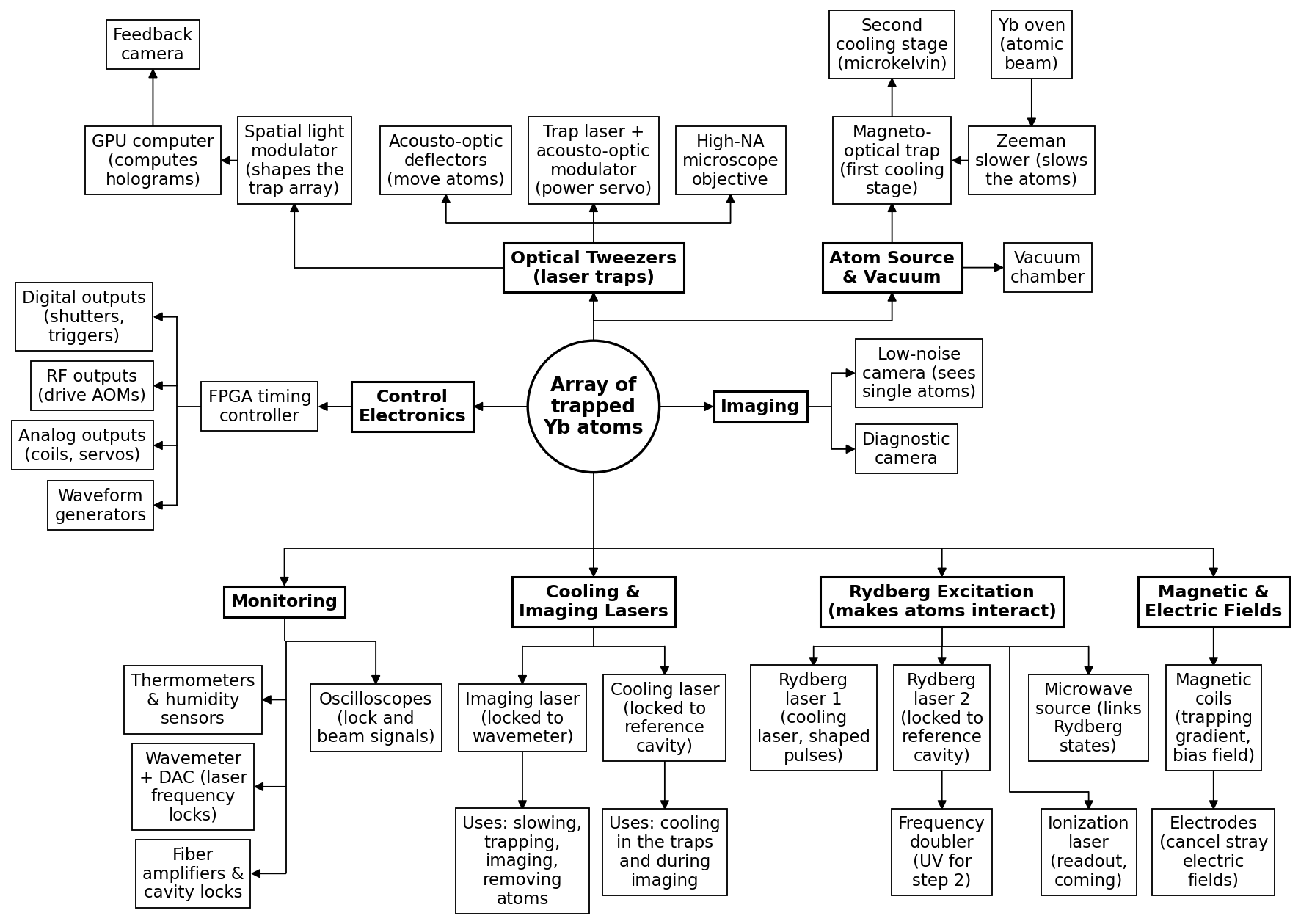
In Figure 1, we outline the basic building blocks of a typical neutral Yb atom array system. Behind the precisely controlled atomic qubits is a complex apparatus. Lasers, electronics, and imaging systems must work together with precise timing, while experimental conditions must remain stable. Keeping this apparatus operating reliably requires sustained attention from experienced engineers and physicists, making round-the-clock operation demanding in both time and personnel.
Maintaining and running the experiment with the help of AI is therefore a natural idea, with early demonstrations already in cold-atom experiments (Wigley et al., 2016), and is itself a frontier problem at the interface of AI and physical science (Carleo et al., 2019).
The more ambitious step is from operating the experiment to doing science. An autonomous scientist would need to ask important questions, choose experiments that distinguish between possible answers, interpret the results, and revise its understanding when the evidence disagrees. Our long-term goal is to connect these abilities into a continuous loop, allowing AI to explore a quantum system at a rate never seen before in pursuit of new discoveries.
A first step toward this loop is to give the AI a learned model of the experiment itself, one that it can query millions of times while the apparatus runs only the most informative experiments. This rests on a division of labor: classical machine learning makes predictions and proposes protocols cheaply (Carrasquilla & Melko, 2017), while the quantum simulator verifies them against physical reality, including in regimes where no classical check exists. Theory supports this split, since for local observables the difficulty lies in generating the data rather than in learning from it (Huang, Kueng et al., 2022; Huang, Chen & Preskill, 2023).
The dipolar XY model shows why this matters. Its phase diagram on frustrated lattices is rich and largely beyond classical methods (Yao et al., 2018), yet experimental realizations are noisy, with finite temperature, positional disorder, and imperfect state preparation. A model trained on the device learns the physics and the noise together, which lets us separate the two (Ito et al., 2026) and design experiments that reach the phases of interest despite these imperfections.
A concrete target
Recent numerical studies predict that the dipolar XY model on a breathing kagome lattice hosts a gapped chiral spin liquid (CSL), a topological phase that has not yet been observed (Machado, Chern, Zaletel & Yao, 2026).
We use our Yb Rydberg quantum simulator, which offers tunable geometry and site-resolved addressing, to train a machine-learning model on the map from local control parameters (site-resolved fields and triangle-level breathing) to measured local observables, including scalar spin chirality on each triangle. Following Lewis et al. (2024), the model exploits geometric locality. For gapped ground states within a single phase, this makes the required number of training configurations grow only logarithmically with system size.
Where tensor-network results exist, they serve as a calibration benchmark for the full pipeline. Because the model is trained on the actual device, it also captures non-idealities such as residual temperature, positional disorder, and diabatic errors. We then use it to design preparation protocols — local-field ramps, anyon-pinning potentials, and edge geometries — that bring the experiment into the CSL regime and extend studies beyond the reach of classical simulation.
Science for AI
But the relationship can also run in the other direction: quantum many-body experiments using neutral atom arrays can help us train better AI.
AI’s progress in mathematics (Trinh et al., 2024) motivates a natural next challenge: learning science through interaction with the physical world. A practical obstacle is the time required to obtain experimental feedback. Many materials-synthesis and biological workflows involve waiting for samples to form, reactions to finish, or organisms to grow (Szymanski et al., 2023). These processes constrain how quickly an AI can test its ideas and accumulate experience.
Neutral-atom arrays offer a different experimental rhythm. Integrated hardware and electronic control allow experimental conditions to be changed through software and measurement sequences to be repeated automatically. The system has the potential of producing high-quality snapshots of quantum evolution at rates from 10 Hz (Li et al., 2026) to 1000 Hz (Zeng et al., 2026). Together with records of the controls and conditions that produced them, these measurements could provide a rich, rapidly growing resource for training scientific models.
Our aim is to use this experimental experience to fine-tune capable open-weight models and develop reinforcement-learning methods grounded in measured outcomes (Guo et al., 2025), turning experience into lasting improvements in the models themselves. Improved models would guide further experiments, whose results would support subsequent rounds of training. Recent work on verifiable LLM agents for quantum many-body simulation (Deng et al., 2026) suggests that grounding in checkable physical outcomes is key to making such models reliable.
This combination of scientific depth, programmable control, and high data throughput makes quantum many-body physics a compelling setting for training scientific AI. Beyond advancing the field itself, we want to explore whether learning how collective behavior emerges from microscopic interactions can help models develop a deeper understanding of the physical world beyond humankind. How broadly that understanding might transfer remains an open question, but the possibility of gaining new insights into complex real-world systems is a central motivation for this effort.
Next: Agentic quantum many-body physics, on the two loops that make this work.