Agentic quantum many-body physics
Two interacting loops: a scientist loop that decides what to investigate, and an engineer loop that keeps the apparatus running.
Our agentic AI system consists of two interacting loops: a scientist loop that decides what to investigate, and an engineer loop that keeps the experiment running.
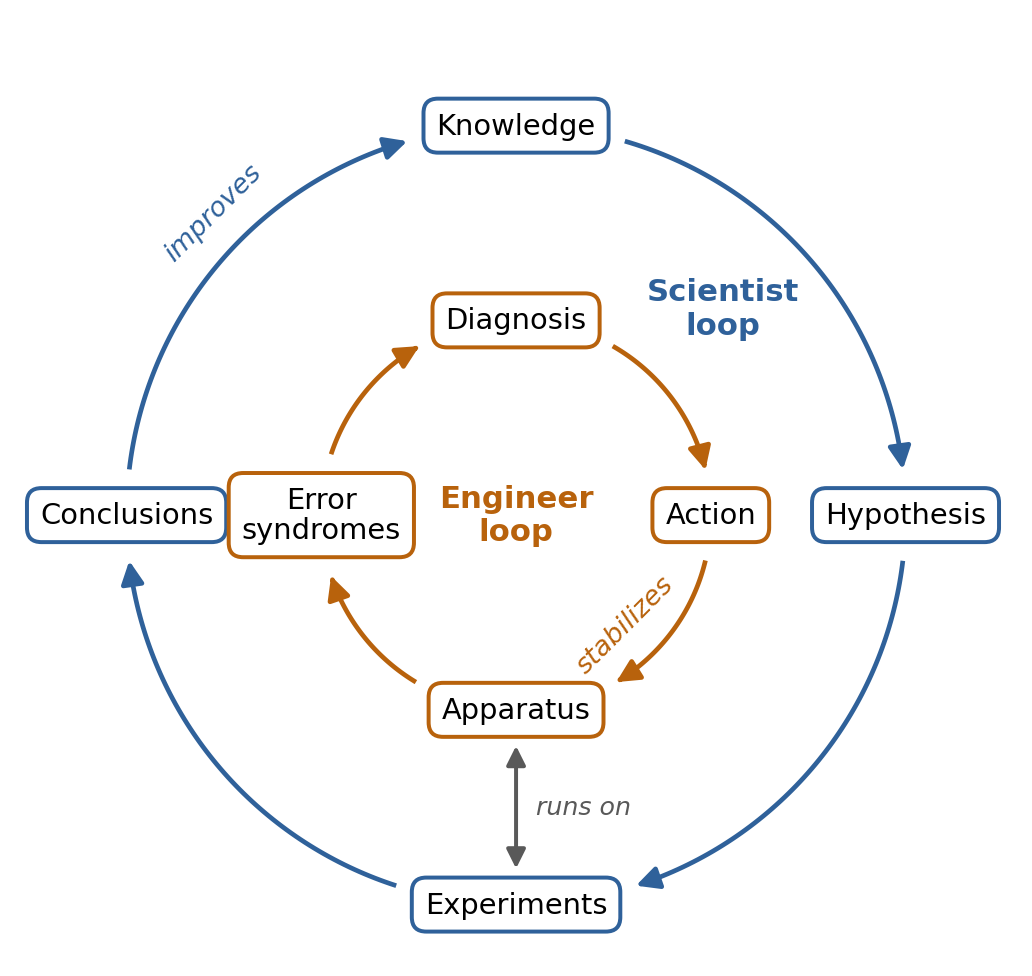
The scientist loop
The scientist loop follows the logic of experimental research: ask a question, formulate a hypothesis, design and conduct an experiment, and use the results to decide what to investigate next.
Closing this loop requires both creativity and scientific judgment — especially the ability to identify which experiment would teach us something new. Improving its capabilities requires broad understanding and reasoning in quantum many-body physics.
While current LLMs can carry out parts of this process with appropriate context engineering, they do not yet consistently demonstrate the depth of insight that leading physicists bring to scientific discovery. We believe fine-tuning on experimental experience could help bridge this gap.
The engineer loop
The engineer loop makes such scientific exploration possible. It monitors the apparatus, diagnoses faults from their symptoms, chooses and applies a fix, and checks whether normal operation has been restored.
This requires detailed knowledge of the particular experiment — the practical experience that researchers often describe as intuition. We have already demonstrated this kind of autonomous troubleshooting on our working experiment through context engineering.
Previously: Neutral-atom arrays and AI, in both directions.